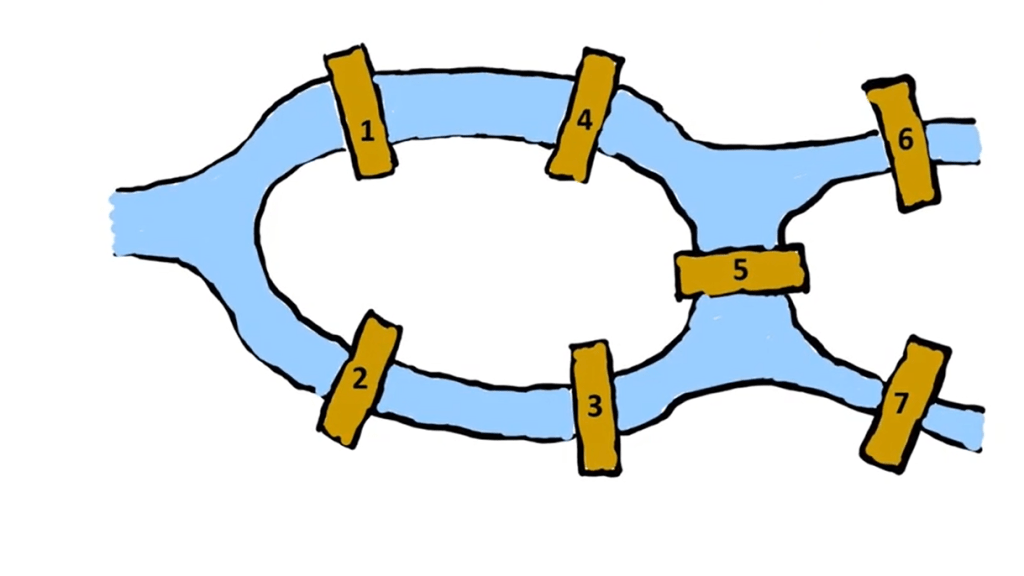
The other day I was talking to a colleague about the Bridges of Konigsberg math problem. I started getting into complexity theory and realized I was confused about some of the details of which pieces of the bridge problem were considered solvable in polynomial time. (Stick with me for one more paragraph, this isn’t a highly detailed math post, although I added a postscript to explain what I was looking up.)
So I asked Claude. And ended up in an exchange for about 10 minutes about all sorts of adjacent problems and concepts. It’s such a different way of “looking something up” than Googling something, or looking it up in a (gasp!) physical encyclopedia. And it has so many interesting ramifications for how we learn and how we think.
When I was a kid, we had reference books. You had a question, you went to the book, you checked the index (or thumbed through entries alphabetically) and found The Answer. In college, I started to use search engines. Suddenly, there were multiple answers easily accessible with the click of a button. I could read something, decide I didn’t understand it, or that it wasn’t exactly answering my question, hit the back button, and try another source.
Where we are now is in a world of what feels like infinite granularity and specificity in how we can get answers to questions. When I go to Claude to find the answer to something, I am doing a lot more than typing a query into a search box. I can zoom in on exactly what I don’t understand or want to know more about. I can customize my learning and understanding from my own perspective, and not waste time on what I already know about.
When I was in grad school, we took an assessment loosely based on the VAK learning styles: Visual, Auditory, and Kinesthetic. My mental model understood those as “learn it yourself from a book” “ask others for help” or “dive in and try it.” Lacking nuance, to be sure, but what I learned about myself was that I relied almost entirely on “learn it yourself from a book” while everyone else was asking each other for help all the time. I made a conscious effort to try and incorporate the other modalities into my learning process, and continue to deliberately do that even now.
What I’ve been reflecting on of late is how the way I’ve been using Claude is a hybrid model – it’s part “learn from a book” but part “ask someone.” While it lacks the Auditory component present in the original model, in some ways it’s a bridge between uni-directional reading and interactive learning that gets me at least some of the benefits of working with others. It forces me to ask good questions, not just passively ingest information. (‘Ask Good Questions‘ is one of my father’s most enduring pieces of advice.) And it vastly lowers the barrier to entry for asking someone: the discomfort (sometimes even shame) of needing to ask for help, especially when it’s something you either think you should know or have asked in the past already. It gets you reps on asking for help that don’t cost anything, other than tokens. 🙂
But it does miss one of the major benefits of “ask someone.” The act of asking someone to teach you something you don’t know or don’t understand is a relationship-building experience. Going up to a colleague and saying, “I think I should understand this but I don’t, I need you” is expressing the type of vulnerability that builds trust between people. They know you won’t walk around pretending to know things, you know they will spare you a few minutes to help you because they think it’s worth it. You appreciate them. They appreciate you.
It also distances us further from the source of the information. Which, in this era of mis- and dis-information can be risky. Now, a person can also tell you what they know without citing a source, and you may trust them. But you generally know their motives, like if they want your job or they want your boss to like them. And even published news sources have recognized biases: I know what I’m getting when I read a piece from the New York Times Editorial staff. What we don’t know when we talk with an AI assistant is what their bias is, or what the biases are in their sources, because that is already abstracted from us. For math, probably fine. For politics, less so.
Claude and the other AI assistants are drastically changing society. Just the other day I heard an interview with an author who writes hundreds of books a year using AI. And an AI-based curriculum that is drastically (and foolishly?) shortening kids’ school days. Those are extreme, and their value to society is up for debate. But I don’t think all the changes are bad, or even debatable. I’m just trying to stay aware of how it’s changing my behavior and my processing of information.
Now, back to the math:
The classic Konigsberg bridge problem describes a city with two riverbanks and two islands, all connected by seven bridges. The question is whether you can cross every bridge exactly once. And the answer is no. What’s interesting is that for any set of land masses and bridges, it’s trivial to figure out if the answer to the question is yes or no by envisioning the configuration as a graph and counting how many edges come out of each node. So it’s considered a P problem, not an NP problem.
Relatedly, however, is the question of if you can visit every landmass exactly once. Funny enough though this question is almost the same, getting its answer is significantly harder. In fact, there’s no shortcut to finding a solution to this type of question that is significantly faster than brute force, which makes it an NP problem.