Monthly Archives: August 2026

Why I say thank you to Claude

I say please and thank you to Claude.

It’s not because I think AI will become our overlords and reward us humans for politeness, and it’s not because I want different responses from Claude. I just do it, the same way I thank the barista at Starbucks for my latte or my husband for going to the dry cleaner. Claude, please can you look at this. Thank you, that’s exactly what I needed.

I’m not alone. And people love to point out that those extra words cost real electricity, that I’m being courteous to what’s effectively a matrix multiplication. At worst, I’ve been told that this is what it looks like when a person gets confused about what’s on the other end of the conversation.

But I think something else is going on. We teach kids please and thank you as manners. Manners are a social contract that is entirely about the other person. You say thank you so the other person feels seen, acknowledged, or appreciated. We don’t tell kids that saying thank you to a vending machine is necessary or important.

But maybe we should. At my daughter’s Bat Mitzvah I referred to gratitude as “an ancient cheat code.” Every spiritual tradition I know of has a significant dose of gratitude built in. Many include practices that require people to demonstrate gratitude, even when they aren’t in the mood. Enter the social scientists. Robert Emmons, who has spent his career on this, defines gratitude as an affirmation of goodness plus a recognition that the source of that goodness sits outside yourself: something good happened, and I didn’t generate it.

So he’s run an experiment on more than a thousand people. He’s instructed them to keep a journal, write down a few things they’re grateful for each day, and do it for a few weeks. The results? The people who do it sleep better, exercise more, report fewer aches, and score higher on basically every measure of well-being.

I’m ok at practicing gratitude. (And it is a practice, so says Brené Brown and many others.) I have a journal that I write in every few days; I practice certain Jewish rituals; I occasionally do yoga. Perhaps thanking Claude is good for me in the same way writing in my journal is good for me. Or perhaps it’s just a reflex. Either way, it’s another observation around my interactions with AI that helps me ensure I’m not the frog boiling in the pot.

How AI is changing how I learn

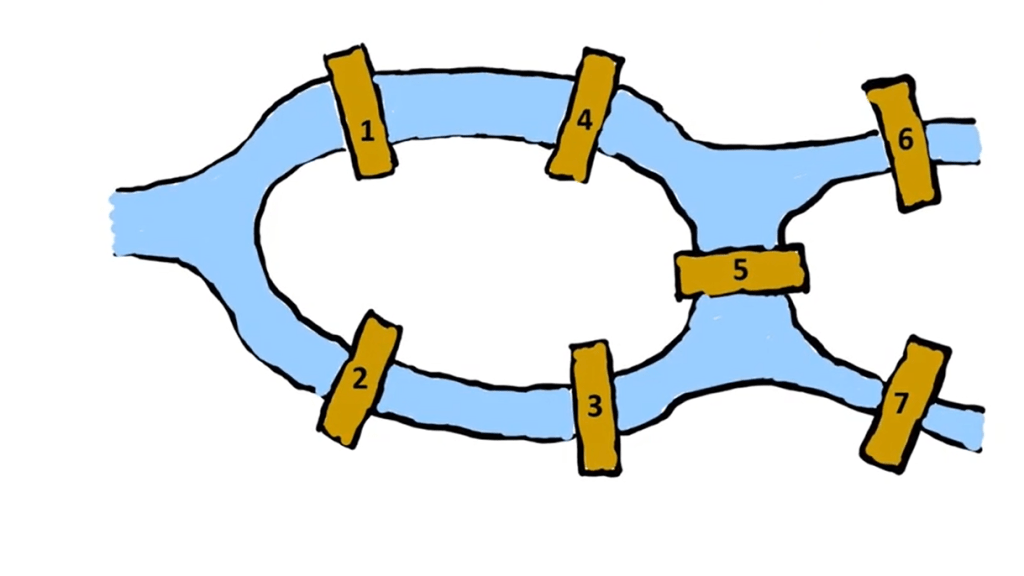
The other day I was talking to a colleague about the Bridges of Konigsberg math problem. I started getting into complexity theory and realized I was confused about some of the details of which pieces of the bridge problem were considered solvable in polynomial time. (Stick with me for one more paragraph, this isn’t a highly detailed math post, although I added a postscript to explain what I was looking up.)

So I asked Claude. And ended up in an exchange for about 10 minutes about all sorts of adjacent problems and concepts. It’s such a different way of “looking something up” than Googling something, or looking it up in a (gasp!) physical encyclopedia. And it has so many interesting ramifications for how we learn and how we think.

When I was a kid, we had reference books. You had a question, you went to the book, you checked the index (or thumbed through entries alphabetically) and found The Answer. In college, I started to use search engines. Suddenly, there were multiple answers easily accessible with the click of a button. I could read something, decide I didn’t understand it, or that it wasn’t exactly answering my question, hit the back button, and try another source.

Where we are now is in a world of what feels like infinite granularity and specificity in how we can get answers to questions. When I go to Claude to find the answer to something, I am doing a lot more than typing a query into a search box. I can zoom in on exactly what I don’t understand or want to know more about. I can customize my learning and understanding from my own perspective, and not waste time on what I already know about.

When I was in grad school, we took an assessment loosely based on the VAK learning styles: Visual, Auditory, and Kinesthetic. My mental model understood those as “learn it yourself from a book” “ask others for help” or “dive in and try it.” Lacking nuance, to be sure, but what I learned about myself was that I relied almost entirely on “learn it yourself from a book” while everyone else was asking each other for help all the time. I made a conscious effort to try and incorporate the other modalities into my learning process, and continue to deliberately do that even now.

What I’ve been reflecting on of late is how the way I’ve been using Claude is a hybrid model – it’s part “learn from a book” but part “ask someone.” While it lacks the Auditory component present in the original model, in some ways it’s a bridge between uni-directional reading and interactive learning that gets me at least some of the benefits of working with others. It forces me to ask good questions, not just passively ingest information. (‘Ask Good Questions‘ is one of my father’s most enduring pieces of advice.) And it vastly lowers the barrier to entry for asking someone: the discomfort (sometimes even shame) of needing to ask for help, especially when it’s something you either think you should know or have asked in the past already. It gets you reps on asking for help that don’t cost anything, other than tokens. 🙂

But it does miss one of the major benefits of “ask someone.” The act of asking someone to teach you something you don’t know or don’t understand is a relationship-building experience. Going up to a colleague and saying, “I think I should understand this but I don’t, I need you” is expressing the type of vulnerability that builds trust between people. They know you won’t walk around pretending to know things, you know they will spare you a few minutes to help you because they think it’s worth it. You appreciate them. They appreciate you.

It also distances us further from the source of the information. Which, in this era of mis- and dis-information can be risky. Now, a person can also tell you what they know without citing a source, and you may trust them. But you generally know their motives, like if they want your job or they want your boss to like them. And even published news sources have recognized biases: I know what I’m getting when I read a piece from the New York Times Editorial staff. What we don’t know when we talk with an AI assistant is what their bias is, or what the biases are in their sources, because that is already abstracted from us. For math, probably fine. For politics, less so.

Claude and the other AI assistants are drastically changing society. Just the other day I heard an interview with an author who writes hundreds of books a year using AI. And an AI-based curriculum that is drastically (and foolishly?) shortening kids’ school days. Those are extreme, and their value to society is up for debate. But I don’t think all the changes are bad, or even debatable. I’m just trying to stay aware of how it’s changing my behavior and my processing of information.

Now, back to the math:
The classic Konigsberg bridge problem describes a city with two riverbanks and two islands, all connected by seven bridges. The question is whether you can cross every bridge exactly once. And the answer is no. What’s interesting is that for any set of land masses and bridges, it’s trivial to figure out if the answer to the question is yes or no by envisioning the configuration as a graph and counting how many edges come out of each node. So it’s considered a P problem, not an NP problem.

Relatedly, however, is the question of if you can visit every landmass exactly once. Funny enough though this question is almost the same, getting its answer is significantly harder. In fact, there’s no shortcut to finding a solution to this type of question that is significantly faster than brute force, which makes it an NP problem.
The silent disruption of PMM

I learned something about flounder last week. To defend against predators, they use chromatophores (tiny sacs of pigment in their skin) to match the color of what they’re lying on. In fact, it’s not just the color, but the texture too.


After going down a rabbit hole on how many plants and animals do something like this, how it works, and what its evolutionary history was, I started to think about what would happen if the ocean itself changed color permanently. Would you notice what happened to the flounder? You couldn’t point at the fish and say “look, it’s different now,” because adapting seamlessly to different environments is already the whole job. The change would be real. It would just be impossible to see.

Everyone is writing about how AI is disrupting product management. Roadmaps, prioritization, spec-writing, even coding itself: there’s a think piece a day. Nobody is writing about how AI is disrupting product marketing. Not because it isn’t. But because PMM has never been one fixed job that a headline writer could point at and say, “that’s what changed.”

Ask ten people what demand gen or PR is responsible for, at ten different companies, and you’ll get ten recognizably similar responses. Ask ten people what a product marketer does, and you’ll get ten different jobs. At one company, messaging. At another, messaging plus competitive intel plus pricing plus half of sales enablement. At a third, positioning, or campaign strategy. I’ve done this job at different-sized companies, in differently mature markets, at different levels of seniority, and I’ve never done the same job twice.

Part of the reason for this is nascency. Modern product marketing traces back to the tech boom of the mid-1980s, which makes it less than 50 years old. Brand marketing, by contrast, has been a defined discipline since the P&G memo in 1931, twice PMM’s age. It’s hard to identify disruption in a discipline that’s still defining itself.

When I started, product marketing was mostly translation: take the technology, explain the value, build the feature/benefit matrix (although I always hated those and one day I killed ours.) There was always pressure to “launch” new products and capabilities, and a friendly friction with product around what deserved a launch and why. Then it became about also understanding buyers: personas, buying committees, understanding that a “customer” was actually a room full of different people with different pains and goals. And the position, meaning how did we define the market we were in and what differentiated role we were playing in it. Then it became about the campaigns around the message itself: what are we putting into market, who’s delivering it, who’s receiving it, how do we know it worked. Each era added responsibilities to PMM teams, stretching the role across functions with increasing tautness.

This AI era that we’re in is not only adding complexity. It’s compressing time and multiplying scale in ways the earlier shifts didn’t. Personas that used to take months now take hours, as long as you have rich source material (like transcripts and engagement data) that can be continually farmed for buyer preferences and behaviors. We can generate hundreds of tailored message variants, for hundreds of accounts, with one push of a button. And perhaps most disruptively, we’re not only messaging to humans anymore. Value and capability now need to be digestable by agents. (Hi, Claude.)

Meanwhile, product is shipping value-rich releases daily, which means the quarter-long, carefully sequenced messaging campaigns I used to plan are becoming as dated as rotary phones. You know, the kind plugged into the wall without buttons? You don’t know?

PMM is being just as disrupted by AI as everyone else. It’s a quieter disruption because of our ability to adjust to our surroundings. The Sheryl who started working in Product Marketing in the ’00’s would hardly recognize what we do today. And I doubt I would recognize where we will be as soon as a year from now.